
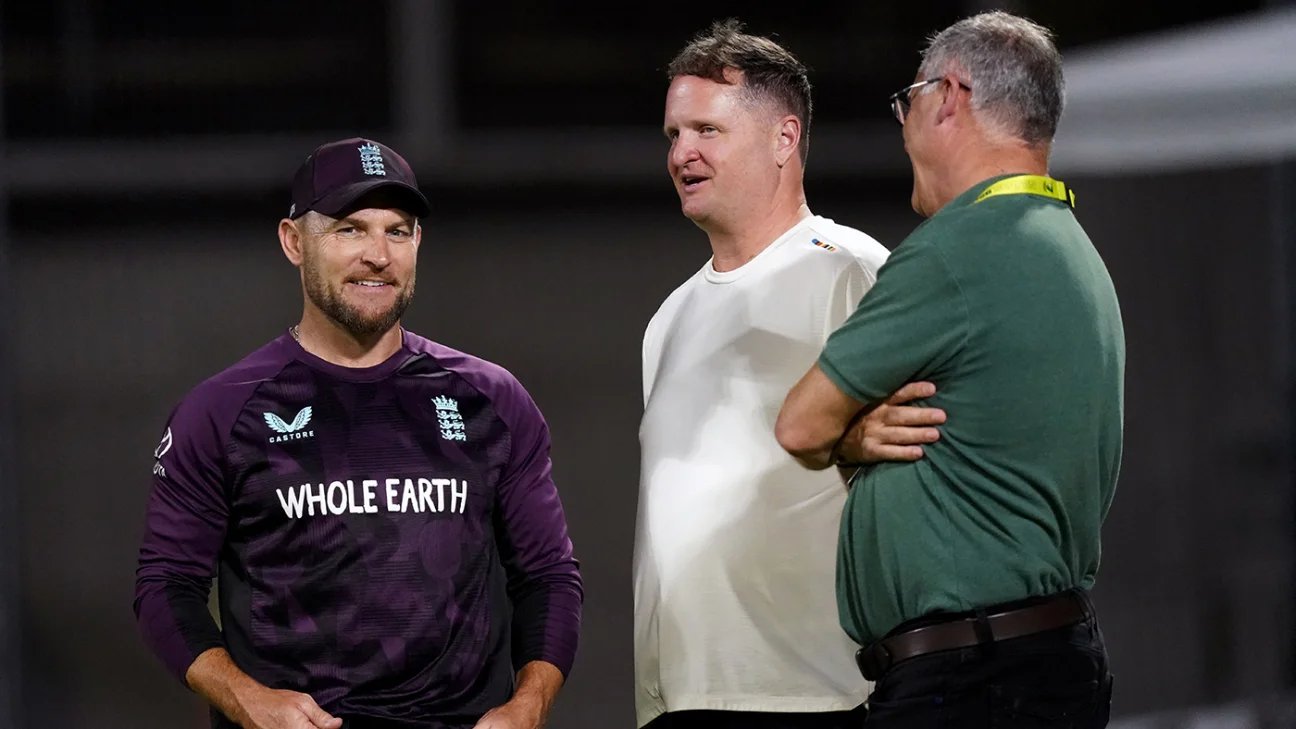
The managing director was under the most pressure heading into the summer, in part because much of the blame for under-performance could be put at his door.
It was Key who expanded McCullum’s remit to all three formats in 2024, after sacking Matthew Mott as white-ball coach, having initially handed McCullum the Test role two years earlier. Key was also responsible for signing off on England’s lacklustre preparations ahead of the Ashes, and admitted his fault after Australia had retained the urn upon winning the first three Tests.
There has been much speculation around Key’s future, especially during the third Test last month, prior to Stokes’ bombshell retirement. Speaking at Lord’s on Sunday afternoon, during day three of the women’s Test between England and India, Gould backed Key for the long haul.
“He’s got a really good brain,” Gould said. “He’s got a good communicator. He has got extraordinary knowledge of what goes on within our game in England. And he has spent the last four years in one of the most difficult jobs in English sports. And the amount of experience that not just he’s amassed, but others within the team, is really valuable for us.”
When pressed on why Key was seemingly untarnished by a run of seven defeats in nine Tests, Gould intimated the 47-year old is vital to a prompt rebuild. That begins with the appointment of a new Test head coach, who will then assist Key in determining Stokes’ successor as captain. The ECB hope to have filled both positions in good time, with a three-Test series against Pakistan beginning on August 19 at Headingley.
“None of us are immune to results, whether it’s coach, captain, director of cricket or chief executive. None of us are immune from results. The key is to make sure that whatever changes we make are the ones that are most likely to bring the most rapid resolution to results that we want.
“We do not have a broken system in English cricket. We have an amazing talent pathway coming up through the counties. We’ve got great crowds, great facilities. Backroom in terms of science and medicine data, both in the men and the women’s game, is in an exceptional position. We’ve reached a semi-final of the most recent men’s ICC tournament, the final of the most recent women’s tournament. So it’s not baby and bath-water, it’s about finding the precise areas where we can improve the quickest.”
It was in March in an ECB boardroom that Gould, flanked by Key, spoke of the need for stability heading into a new cycle, and the broader focus on “revenge” in next summer’s Ashes. At the time, he stated “moving people on can sometimes be the easy thing to do”.
Confronted with those same words on Sunday, Gould would not be drawn on whether he was embarrassed to have now taken the decision to stand down McCullum: “Positions particularly in sport, and English cricket, change very quickly and we need to be able to react to those conditions and those situations when they do.”
He did, however, admit that he had considered his own position as chief executive, while defending his overall remit.
“I consider my position on a daily regular basis, yes. Because these jobs are a privilege and you always want to make sure they’ll feel confident that you’re trying to drive the team, the sport in the right direction possible.
“These jobs, particularly in cricket, are quite complicated because, unlike the FA, it’s got the England teams, it’s got domestic teams, it’s got grassroots cricket. And I think I would look at my performance in the round if I was going to be generous. But also I know, we all know, that we need high-performing teams on the pitch.”
Vithushan Ehantharajah is an associate editor at Cricinfo
