
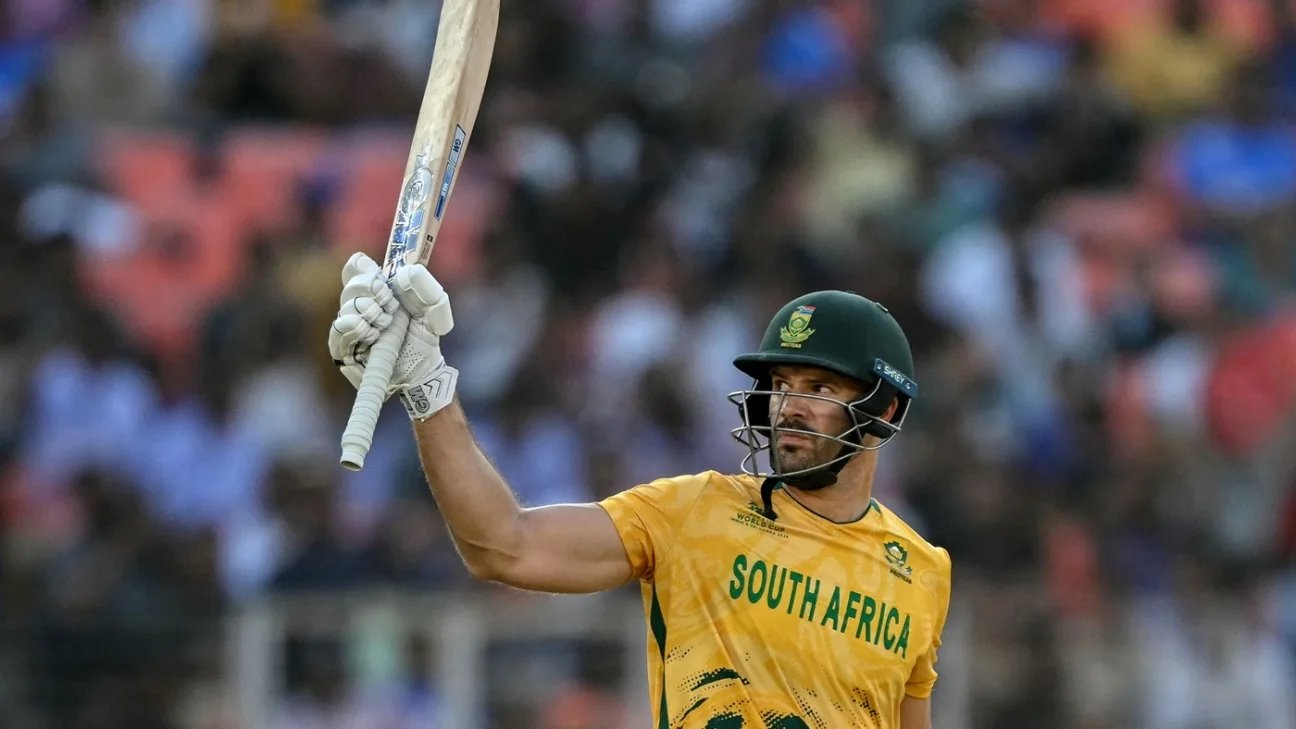
South Africa 177 for 1 (Markram 82*, de Kock 47, Rickelton 45*) beat West Indies 176 for 8 (Shepherd 52, Holder 49, Ngidi 3-20, Rabada 2-22, Bosch 2-31) by nine wickets
Shepherd’s unbeaten 52 – a maiden T20I half-century, sealed with an inside edge for four off the final ball of the innings – and a well-managed 49 from Holder was a part change of tact. But even they focused on finding the fence throughout their 57 deliveries together rather than ticking over to bat time, even if West Indies were able to use all 20 overs.
South Africa were far from perfect, dropping four catches and being a little passive in the field. But they took it to West Indies’s bowlers. All six used by Shai Hope ended up wearing economy rates in double figures, as de Kock’s 47 off 24) and then Ryan Rickleton’s unbeaten 45 off 28 dovetailed neatly as left-handed foils to Markram’s belligerent march to the finish line.
Openers underpin South Africa’s batting brilliance
If Markram and de Kock had found five more runs between them, they would have become South Africa’s 8th opening pair to register a century stand. In the grand scheme of things, it’s not a particularly meaningful stat. Because their 95 did what it was supposed to; hacking out more than half of the target inside eight overs. But it would have been an impressive milestone for a partnership thriving in its relative infancy.
The next innings will be Markram and de Kock’s 10th at the top of the order since head coach Shukri Conrad threw them together after de Kock came out of international retirement. That will make them South Africa’s fifth-most frequent pair. That de Kock features in all of the top three is a nod to his legacy and class as the aggressor alongside the likes of Reeza Hendricks, Temba Bavuma and Hashim Amla. Thus, the best testament to his union with Markram is how comfortable he seems playing the straight man.
A ball into the final over of the powerplay, de Kock had faced just 11 deliveries, with one boundary struck in a score of 9. At another time, he might have been tetchy. But the scoreboard read 53 for no loss – their third fifty stand of the tournament – and Markram had 43 of those, happy to take on the burden of risk. It allowed de Kock to feel his way into the game after struggling against UAE (14 off 16) and India (6 off 7) in his previous two innings.
From that point on, de Kock came to the party, accelerating with 38 in his next 11 deliveries with the help of four sixes. During that period, Markram was on strike for just four balls, scoring four runs. That ability to swap roles effectively is a sign of a functional relationship between the two that underpins South Africa’s brilliance with the bat.
West Indies stick to their principles
A decade ago, Daren Sammy was captaining a West Indies side to their second T20 World Cup with a batting strategy that placed heavy emphasis on hitting boundaries. For the first half of their innings today, you wondered if now, as head coach, he had pushed that ethos too far.
At 83 for 7, the game was as good as done. Persisting with the aerial route ultimately proved terminal given six of the top seven were caught – Hope, Shimron Hetmyer and Sherfane Rutherford after already benefitting from drops.
In the end, it did come good. as Holder and Shepherd resuscitated the innings to take West Indies to 176. Of that total, 126 came in boundaries, having played out 53 dot balls across their 20 overs. Of those dots, 19 came in that record eight-wicket stand, with Holder and Shepherd between them contributing seven of the 11 sixes launched. It seems likely that West Indies will find consolation in what the pair was able to cobble together. And they could even point to justification given the ease and swiftness of South Africa chase. Clearly, a bumper score in excess of 200 was necessary on this deck.
South Africa’s World Cup to lose?
They held their nerve in the double Super Over victory against Afghanistan. They dominated defending champions and standout favorites India. Here, they have breezed to victory against the only other unbeaten team in the tournament, and two-time winners, West Indies, without even playing that well.
Markram’s decision to open the bowling with Keshav Maharaj – the first time he had done so at this tournament – was a well-meaning punt that backfired as the left-arm spinner was taken for 17. There were four catches missed in the field, the most costly when Maharaj missed the chance to dismiss Holder for 23. And the bowlers went searching as the stand between Holder and Shepherd grew.
As the cliches go, the best teams find a way even though when they are out of sorts, and they also find different ways to win. South Africa have already found success in many forms… but what of the ultimate prize?
Well, the squad has a bit of everything, including plenty of survivors from the heart-breaking defeat in 2024’s final. Rewards for Rabada – who doubled his wicket-tally for the tournament – and a score of note for de Kock, after three failures after his fifty against Afghanistan, mean everyone in the XI has had a taste of glory.
Factor in that the final will likely be held in Ahmedabad, South Africa’s home away from home at this World Cup (played five, won five), and it is hard to look past them. Jinxes be damned – their wait may soon be over.
Vithushan Ehantharajah is an associate editor at ESPNcricinfo
